Tuesday, January 26, 2010

10 Ways You've Changed in the Last 10 Years: A Survey of Reflection and Style


by Jocelyn M. Goode

"The Thong Song", black boot-cut pants (a.k.a. bitch pants), studded aviator glasses, the election of George W. Bush, Y2K panic, velour warm-up suits, trucker hats, exposed midriffs and navel rings, "So Fresh, So Clean", Destiny's Child...the list of trends and popular culture highlights from the year 2000 could continue.

Now, it's 2010, ten years into the new millennium. As long as a decade is, 2000 doesn't seem that far back. However, much has happened in fashion, art, technology and politics and most of us have shifted our opinions and changed our perspectives over the past years. Just as style has evolved and the landscape of ideologies has morphed, so has the way many of us view the world.

FAIM Internet Magazine invites its readers to reflect upon 10 ways they have changed in thought and in style since the turn of the century. Complete the following statements to measure your own shifts. Copy them from the body of this post and paste them in the comments section along with your answers. Feel free to get your friends and family to take the quiz and check back to see what other readers have to say.


Part One: Perspective
1. 10 years ago, my greatest accomplishment was...
Now, my greatest accomplishment is...

2. 10 years ago, I thought happiness came from...
Now, I believe happiness comes from...

3. 10 years ago, I used to struggle with...
Now, I struggle with...

4. 10 years ago, I thought that sex was...
Now, I think that sex is...

5. 10 years ago, my biggest fear was...
Now, my biggest fear is...

6. 10 years ago, my ultimate goal was...
Now, my ultimate goal is...

7. 10 years ago, I thought cheating was...
Now, I think cheating is...

8. 10 years ago, my thoughts on spirituality/religion were...
Now, my thoughts on spirituality/religion are...

9. 10 years ago, I paid...amount of attention to politics.
Now, I pay...amount of attention to politics.

10. 10 years ago, I defined success as…
Now, I define success as...


Part Two: Style
1. 10 years ago, I spent...hours a day using the Internet.
Now, I spend...hours a day using the Internet.

2. 10 years ago, my guilty pleasure was...
Now, my guilty pleasure is...

3. 10 years ago, I would describe my social life as...
Now, I would describe my social life as...

4. 10 years ago, I had...piercings/tattoos.
Now, I have...piercings/tattoos.

5. 10 years ago, I would never have...
Now, I would never...

6. 10 years ago, my favorite party song was...
Now, my favorite party song is...

7. 10 years ago, I had...best friends.
Now, I have...best friends.

8. 10 years ago, I felt that marriage was...
Now, I feel that marriage is...

9. 10 years ago, I thought I looked best dressed in...
Now, I think I look best dressed in...

10. 10 years ago, I was...years old.
Now, I'm...years old.

Wednesday, January 20, 2010

Haiti Help or Haiti Hoodwink?

by Jocelyn M. Goode


Young child being rescued from rubble in Haiti

Not since the levees exploded in New Orleans and caused the devastation attributed to Hurricane Katrina, have the people of the U.S. been so committed to relieving the suffering of Black people. The response to the tragic situation in Haiti exacerbated by the recent earthquake has resulted in an outpour of financial support and expressed concern. At every turn and click, there are announcements of Haitian relief fundraisers and advertisements soliciting donations. The turmoil, death and agony that millions of Haitian people are presently experiencing are pulling at our collective heartstrings. But what does all of our money and care really do to help the massive problems?

Victims of Hurricane Katrina
Victims of Haitian Earthquake
Victims of Hurricane Katrina
Victims of Haitian Earthquake
Victims of Hurricane Katrina
Victims of Haitian Earthquake
Damage done by Hurricane Katrina
Damage done by Haitian Earthquake

The country of Haiti historically has been the target of economic and political ploys led by the United States and other "first world" nations. Ever since Toussaint L'Ouverture led the people to victory against the French, eliminated slavery and made Haiti the first republic ruled by people of African ancestry in 1804, the dominating world powers have made sure that Haiti suffered. From 1915 to 1934, the United Stated occupied Haiti, as it frequently does to countries worldwide, to establish "democracy" and to put down resistances from "terrorists". However, the U.S. gave Haiti as $40 million loan in 1922 that accounts for creating a shaky financial structure in the country. Because of the hefty debt, much of the country's wealth went to paying creditors abroad rather than economic investment in Haiti.
Most of the population is undernourished, a majority of whom are children under 14 years of age.

For decades, Haiti has been one of the world's poorest and suffering nation. In 2004, the World Bank reported that the GDP per capita was $480 compared with the average income in America of $33,550. The literacy rate was 50%, life expectancy was a mere 49 years, 50% of the people were living in starvation, 40% of the population was under 14, and Haiti had the highest incidence of HIV/AIDS in Latin America and the Caribbean with 4.5% of the population--300,000 people affected by the epidemic.


Where was the aid over all these years? Actually, the United States has much to do with the economic and political crises in Haiti that existed well before this latest earthquake. The International Monetary Fund (IMF) and the World Bank forced Haiti to drop import tariffs as a way to repay owed loans. In 1994, Haitian President Jean-Betrand Aristide made a deal specifically with the U.S. to make import tariffs between zero and 15 percent in exchange for American protection. As a result, Haitian agriculture, which was sufficient enough to sustain the nation, was no longer able to compete with cheap, lower quality imported foods arriving from the U.S. With no tariffs and taxes, Haitian products could not compete with foreign prices, causing further economic turmoil for the country. Finally in 2000, the United States cut off the $165 million in aid that Haiti received annually, claiming over 70% of the money was going to corrupt officials.
Haitian refugees heading to Florida

The list of socio-political inequalities in Haiti continues with unequal treatment of Haitian immigrants versus ones arriving from the Dominican Republic or Cuba, no direct foreign investment in Haiti and a lack of clean water and sanitation to over half the population.

Clearly, Haiti has been in need of relief fundraisers and financial support for decades. Why now, is it that people are giving so generously? Is it because the media has put the spotlight on the latest tragedy? Will the flow of money slowly subside the way it did once Hurricane Katrina and the horrors happening in New Orleans were no longer "news"? And what exactly is happening with all the money being raised? How are we able to guarantee that the people of Haiti have any type of agency in determining how they are helped?
Labadee Beach, Haiti

I raise these questions not to say that people should not attempt to help, but that perhaps they ought to rethink how they help. At this point, most of us do not have the ability nor the resources to go to Haiti and build a hospital or create the necessary infrastructure truly needed to "relieve" the ailing nation. However, our agency in this country carries a little more currency. There needs to be mobilization in our local communities which demands full disclosure of what the politicians of this country are doing each day, and where the money is going specifically. By holding the "powers that be" accountable and enacting consequences for unaccountability, we ensure that our power as citizens, not just our dollars, brings aid to the situation.
Not your typical "Relief Fund" event...

In a capitalistic society, throwing money at the problem, feels right. You can sleep at night knowing you contributed to the solution. Yet, if seeing Haiti as a stable, competitive, self-sufficient nation is truly the goal, then it will require a different kind of sacrifice from Americans. This type of action has been rare on a mainstream level in this country since the 1960's, however it is time for the masses, the everyday people, to organize and exercise their political might to bring the true change they want to see.
The real cost of sacrifice to see change. Do people still have this type of passion?
Article Sources:
http://news.bbc.co.uk/2/hi/business/3522155.stm
http://www.heritagekonpa.com/archives/Haiti;s%20rice%20farmers%20suffered%20since%20trade%20barrier%20in%201994.htm
http://news.bbc.co.uk/2/hi/programmes/cooking_in_the_danger_zone/7302535.stm
http://en.wikipedia.org/wiki/Haiti

Wednesday, August 12, 2009

In the Spirit of a Queens Queen-Doris Ward

Lonnie Youngblood

In the Spirit of a Queens Queen-Doris Ward

story and photos by Jocelyn M.Goode


Melodic jazz tunes rolled through the evening summer air as a Jazzmobile band warmed up for their set. The quartet included a congo drummer, an electric guitarist, a keyboardist, and Lonnie Youngblood, the lead singer. Jazzmobile is a traveling jazz festival that celebrates acclaimed artists from the U.S. and abroad who are regular performers by bringing live, free concerts to neighborhoods in Harlem, New York. For the sixteenth year in a row however, Jazzmobile musicians arrived on 198th St. in Hollis, one of only two Queens neighborhoods that the Harlem festival reaches. How did this quiet block become the recipient of such an annual special performance? The answer lies in the enduring effort and spirit of Doris Ward.
Doris Ward's close friends lounging on her front lawn


The late, great Lady D. as her friends lovingly donned her was known as a generous entertainer, fierce fashionista and avid lover of jazz. After retiring from serving as a nurse on Riker's Island Correctional Facility, Doris ran a home-based fashion business and hosted spectacular shows regularly. Even though she resided on 198th St in Hollis, Queens, she traveled visited often her hometown of Harlem to hear the latest from the most popular jazz artists of the moment. Her passion for culture and bringing people together led Mrs. Ward to coordinate with the 198th St. Block Association. Almost two decades ago she was able to influence them to use their entertainment budget to support Jazzmobile and to bring live, jazz concerts to her street. They have been doing so ever since.198th St. in Hollis, Queens

Lady D's reputation as a woman who made big things happen was echoed by those who knew her closely. Her popularity had the streets filled every year with friends, families and community members who knew that the Jazzmobile concerts also sparked BBQs, kids playing and the inter-generational socializing. While this year's concert was the first without Doris Ward as she transitioned in March 2009, her spirit lives on in the people she touched. Her closest acquaintances had this to say about her:
Lady D.'s friends missed her dearly but still jammed to the jazz!


"She was a lady of elegance. If you knew her, you could love her...She was a woman to be reckoned with."-Margie Ginn


"She had a good heart. She would tell you like it is...she was very frank. She was a short little lady and she dressed like a royal queen."-Jean Nichols


"She was a joy...She's from the jazz era, that's why she loves Jazzmobile."-Gloria Butcher


"She was a person that didn't want to see anyone without. She would do what it takes so you could have what you need. She was a beautiful person."-Jacquie Rucker


Doris Ward expertly practiced what FAIM Internet Magazine stands upon--utilizing common culture to connect communities. Jazzmobile's latest concert on 198th St. was beautiful as whole families from grandparents to toddlers bobbed their heads to classic jazz tunes. The lead singer and saxophonist, Lonnie Youngblood even convinced several seniors and teenagers to form a chorus line, doing Rockette kicks to his rendition of "New York, New York".


The legacy that Lady D. created by instituting such a unifying tradition will continue to endure. The next generation is now taking on the responsibility to ensure that Jazzmobile keeps returning to 198th St. in Hollis, Queens. To learn more about Jazzmobile visit their website at www.jazzmobile.org


Tuesday, July 28, 2009

FAIM Internet Magazine Goes Underground for Expansion

FAIM Internet Magazine Goes Underground for Expansion
story, photo and video by Jocelyn M. Goode

On December 31st, 2008 a pregnant thought delivered in the mind of Jocelyn M. Goode, the multi-talented and eclectic creator of FAIM Internet Magazine. The thought was more like a vision where people could read about the experiences of others finding ways to utilize creativity and culture to create commerce and social progress. The vision gave birth on January 1st, 2009 to a publication focused on fashion, art, interactivity and movement catering to creative, open-minded, forward-thinking, analytical and entrepreneurial people.


The acronym defines the scope of the magazine. Fashion is undeniable; it is expressed in the daily choices people make as they dress themselves. Art is personal expression manifested through form and material. Interactivity is participation and exchange. Movement is organized events progressing toward an objective. Over the past 7 months, FAIM Internet Magazine has featured over 15 profiles and events taking place primarily in the Bay Area and New York City. At its peak, articles published every Tuesday by the end of the the West Coast business day. Still, the nascent publication has leaps and bounds to grow.


Therefore, as of Tuesday, July 28th, FAIM Internet Magazine is going underground for expansion. The response to the articles has been encouraging and appreciative. Also, opportunities have arisen to elaborate the operation, which will require development time underground. Stay tuned for short bites and clips like the one below, that will be released intermittently during the metamorphosis. FAIM Internet Magazine is on twitter; follow us for tweets announcing fresh content.


Harlem, NYC-June 2009

Tuesday, July 14, 2009

The Artful Design of Afrikanation: Introducing Ebony Iman Dallas

Artist and Designer, Ebony Iman Dallas

The Artful Design of Afrikanation: Introducing Ebony Iman Dallas
by Jocelyn M. Goode, photos by Ebony I. Dallas

Throughout history, many artists have faced the challenge of applying their creative skills towards a tangible and relevant purpose. While art has the ability to evoke emotion and inspire action, it also can be devoid of direct meaning making it no more than a pleasurable yet superfluous commodity. Managing the freedom of expression against the purpose of resolution has been a balancing act that Ebony Iman Dallas embraces with her bourgeoning project, Afrikanation Art Exchange.

In the Spring of 2009, Ebony completed a Master of Fine Arts degreein Design from the California College of the Arts. The Afrikanation Art Exchange began as her thesis project designed to unite all people of African decent and supporters through art for community activism. In a recent interview with FAIM Internet Magazine Ebony states, "many of the challenges among African descendants worldwide are very similar and by joining hands, solutions can be created to dissolve them." The project is an organized collaboration between artists in Oakland, CA and artists in Burkina Faso and Mali.

Ebony (right) conducting an interview with an artist
On Friday, July 17, 2009 in Oakland, CA, emerging and established artists ranging from spoken word to musicians will share their art at the second Afrikanation event. Local community activists will speak and culinary masters will provide spicy jerk chicken and BBQ while raising funds for Art Esteem and Project Open Hand. Art Esteem is an organization that provides art therapy to over 3,500 Bay Area youth and Project Open Hand provides meals for over 2,500 people per year living with HIV/AIDS in the Bay Area. There is no cost to attend but donations will be taken to support these causes. Participating artists and vendors have agreed to donate 10% of sales to these organizations to continue their missions.
One of the speakers at the first Afrikanation event
Ebony's endeavors have already been received with success. The first Afrikanation event was entitled Pan-African Potluck and was simply an invitation for people to share artwork, food and music. This also took place at Coffee with a Beat in Oakland, CA with about seventy people in attendance. Local newspapers covered the event praising it for its originality and inclusiveness.


However, not everyone has been able to grasp the true purpose of Ebony's project. It is not often that artists of the African diaspora are the center of artistic dialogues. Because the project has such a specific focus, some dissuaders feel left out. When asked about her challenges with Afrikanation Art Exchange, Dallas shares, "this project may seem “exclusive” to some. The point of this project cannot be defined in such simple terms. It is a challenge to unify all people of African descent as well as supporters in order tackle issues in these communities. One huge issue that I would like to address in a big way is the HIV/AIDS crisis. These problems will not simply disappear by not talking about them. Anyone desiring to help is gladly welcome. "
Art by Ebony Iman Dallas
So what motivates a young artist to take boldly commit to an ambition of this size? Ebony Iman Dallas, originally from Oklahoma City, OK, is of African-American heritage with her mother and stepfather from the US and her father from Somalia. She moved to Oakland in 2004 to work at an advertising firm and soon found herself grappling with deeper issues as a designer and artist. The following is an except from our interview where she reveals her personal journey as a creator and innovator.
Art by Ebony Iman Dallas
FAIM: How would you describe yourself as an artist and your personal art?
EID: As an artist I am always looking for ways to challenge myself. I recently did my first live painting session at an open mic and I must say I was nervous at the thought! I did it because I knew that if I didn’t try it once that I would not know if I would a second time. Now I can say that I gladly would!
Art by Ebony Iman Dallas
FAIM: What are your major influences and sources of inspiration?
EID: Progressive people and spirituality. I know that I am not in this alone and that is the only thing that keeps me going.


Art by Ebony Iman Dallas
FAIM: What is the difference between art and design?
EID: Design is about problem resolution and art is about expressing ideas in a personal way.


FAIM: How do they work together?
EID: I’ve been trying to figure that one out myself! In my personal experience, my most successful design pieces (print and web design) began with art. I usually use charcoal to create iconic images then scan them into the computer and alter them. I am more comfortable using this method rather that going directly into the computer to create. Some people are the opposite, but this is what works for me.


FAIM: What are your greatest lessons learned as an artist and designer?
EID: The art vs. design discussion can stir up fiery conversations but for me it’s about accepting both the artist and designer in me, and not being afraid to admit it.


FAIM: Any advice that you would like to offer?
EID: Take chances. You never know what lies around the corner if you don’t. If you are unhappy with your place in life as it involves a job, relationship or other, take a chance and don’t be afraid to change! What do you have to lose? The only scary part is knowing you will be in the same place if you don’t!


Please go to HYPERLINK "http://www.eidart.com/afrikanation" www.eidart.com/afrikanation for more info or email Ebony at eid@eidart.com.

Tuesday, July 7, 2009

Hollis Hip-Hopreneur-an Innerview with Orville Hall

Hollis Famous Burgers team with Chef Unique in the center and Orville Hall on the right
Hollis Hip-Hopreneur-an Innerview with Orville Hall
Story and photos by Jocelyn M. Goode

Hollis, Queens is famous for its rich legacy in producing Hip-Hop greats like Run-DMC, Jam Master Jay, Russell Simmons, Davy D., LL Cool J, Ed Lover, Irv Gotti and Ja Rule. Marketing mastermind Orville Hall has found a way to tell the story of his historic neighborhood lovingly dubbed "the Motown of Hip-Hop". On July 4, 2008, he opened the doors to Hollis Famous Burgers and the Hollis Hip-Hop Museum. The two-in-one combo offers a menu of soul food favorites with dinner plates at $7 and a $1 mini-burger which is made from fresh ground beef and seasoned to order. On Saturdays patrons can watch popular Hip-Hop and sports shows on flat screen televisions while enjoying the day's special of steamed crab legs.

Owner Orville Hall personally serves patrons every weekendThe restaurant and museum have two flat screen televisions and a computer with internet connection
Hip-Hop memorabilia adorn the walls of Hollis Famous Burgers, including an oversized, airbrushed mural of the late musical genius Jam Master Jay. Gold and platinum encased records, autographed photographs, swinging pairs of Adidas and other artifacts of Hip-Hop history certify that restaurant truly houses its own museum.


FAIM Internet Magazine, which is presently stationed in Hollis, Queens, had the chance to learn about what it really takes for Orville Hall to be a Hip-Hopreneur. The following is a paraphrased interview held on Sunday, June 28.


FAIM: When did you first open the doors to Hollis Famous Burgers and the Hollis Hip-Hop Museum?
OH: July 4, 2008.

FAIM: What is the significance in establishing Hollis Famous Burgers?
OH: This neighborhood has the most music culture in NYC.There was a time when we knew that, because we lived it. But we have forgotten it. The spot is here to remind young people of this neighborhood of who they are, and to inspire them. Hollis is one of the last American neighborhoods. Everybody knows each other. My kids have kids whose kids come here. We take pride in feeding people here.

Line Chef Vernita and a loyal neighborhood patron
FAIM: As an entrepreneur, what we were the factors you considered when making the decision to open?
OH: My entrepreneurial spirit made me try it! This was previously a restaurant that had been here for over 30 years and was closing down. Everyone on the walls of Hollis Famous Burgers had eaten there. It was a community place and a popular hangout for many people. It would have been terrible to lose the place. Where would everyone go?
I took out 401K money and just did it. I didn't think that much about it.
Chef Unique had been doing business with me for a while. Having her made it feel easier because I knew I had a cook. Not knowing about the business beforehand, I came up with a good selling structure where I don't have to waste much.
It was the entrepreneurial spirit that made me jump and do it.
It's a very hard business--the food business. But I didn't think much about it.

Head Chef UniqueGrill Chef Harold
FAIM: What is your professional background and training? How did they impact your capabilities for this venture?
OH: For 15 years, I was the Director of Urban Marketing for Adidas. In 2008, I became the Global Marketing Consultant for FILA. Also, I am Director of Marketing for Polo Grounds Music/J Records which is home to artists like Hurricane Chris, Pitbull, Nina Sky and Yo Gotti.
The part of my experience that I utilized most was the marketing side--recognizing a great story, telling the history of Hip-Hop in Hollis, Queens and packaging the story of this neighborhood. We didn't ask anyone for help, not from none of the celebrities on the wall. We built it.


FAIM: What were your first 6 months like?
OH: We had to learn how to buy food and how to manage amounts to make a profit because at the end of the week you need physical cash to pay everyone.
I also knew that I had to make the place bigger than the people who stand outside of it. We keep our doors open for people to hang out and talk, even after we shut down the kitchen. We have held free Thanksgiving Dinners, Free Kids days in the park and toy drives for the Britney House which is a shelter for young mothers. This is a community business--anyone who comes in here and is hungry, we feed 'em, we don't turn anyone away.

Destiney, Hollis Famous Burgers cashier
FAIM: What role do you want the community to play? How do you want them to interact with your businesses?
OH: I want them to support it. I want them to eat here. I built in their face so people could see the process from scratch. Some businesses cover up their front windows when building so it can be a surprise when it opens. We didn't. We let everyone see that we built this ourselves. We don't hide the struggle of running this business from the community. It's hard! Everyone saw when they came and repossessed my car right from in front of the restaurant. And everyone saw when I got it back.
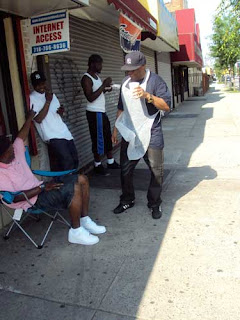
FAIM: What has been the greatest surprise, something unexpected but a blessing that happened?
OH: We got a write-up in the New York Times for our grand opening. It was a great surprise because the NY Times goes out to the world. They really praised us.
Just as important is the exposure we received from The Village Voice, History Channel and BET Behind the Scenes.
Tourists have come from Japan, London, Norway and Australia. It's validating because they expect it not to be as good as what they have heard and they leave here happy.

FAIM: What advice do you have for those considering becoming entrepreneurs?
OH: When you are an entrepreneur, look at everything as money. Look at how you can connect your dots, find a way to make it all work together
I want people to take from this that it doesn't matter what you want to do, just try! It's not gonna be easy, it's not gonna be peaches and cream but you hang in there.


To learn more about Hollis Famous Burgers and the Hollis Hip Hop Museum, visit www. hollisfamousburgers.com